Happy 80th, Michael Rosen! (7.5.1946)
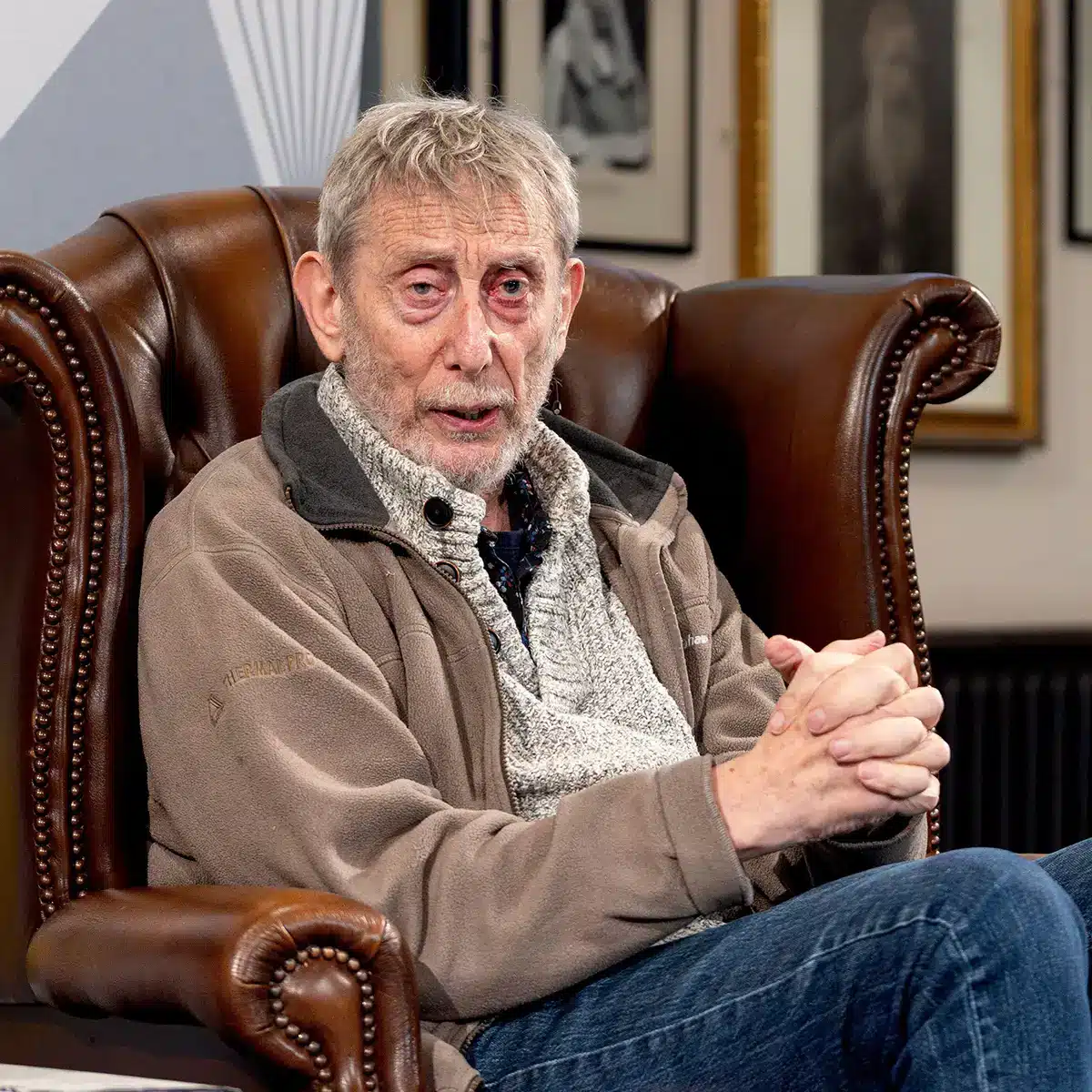
Alamy / Mike OBrien
Nun ist er schon 80, der von dem Alten so geschätzte Michael Rosen!
Nice, isn´t it?
Wo er herkommt, beschreibt Michael Rosen eindrucksvoll in seinem Erinnerungsbuch von 2017 So They Call You Pisher – A Memoir. London, Verso.:
«All these people were Jews, the oldest among them speaking Yiddish, which by the time I came along didn’t exist as a flow of talk. It came interwoven into English, as words and expressions, remnants of one language alive and well in another. It was good for swearing, describing anyone as foolish, crazy or nonsensical; anything to do with eating, gobbling, slurping and things tasting good; anything to do with saying that people were bad because they were thieves, bastards, know-alls, blabbermouths, spongers, tramps or slobs.
It was good for distinguishing a useless person from a big shot. There was a raft of phrases and sayings to say the unsayable. There were three ways of saying you were in trouble. Not so bad trouble, you were in tsures; bigger trouble: ‚You’re in shtuch.‘ Serious trouble? ‚You’re in dr’erd.‘
Do me a favour! (meaning, do me a favour by not saying what you’re saying): Tut mir ein toyver.
Be good and help me out there: Sei a mensh.
And for any time you needed to say, ‚kiss my ass‘, there was kish mir mein tukkhes.
If you didn’t know whether to risk saying something, what’s the worst that could happen? ‚So they call you pisher!‘
There were even words my parents said that they didn’t really know what they meant but they said them all the same: a plate of nice food in front of us, and my father would say, ‚Shnobbrergants‚. It didn’t mean the food was nice. It meant something like, if I was a shnobbrergants I’d gooble this stuff up – but he didn’t know what a shnobbrergants was. And a mess, for my mother, was a misherdamonk.
My father used more Yiddish than Mum did. I’m guessing that when he saw me, he named parts of me: there was my pipik, my tukkhes, my punim (belly button, bum, face). Most likely he used Yiddish to describe this baby’s bodily processes. ‚Con‘, he’d say (it wouldn’t have been his job), ‚he’s kvetsht up his milk‘, ‚he’s grepst‚, ‚he’s fotzt‚ (he’s puked up his milk, burped and farted). When I winced, ‚Con, it’s something in his kishkes‘ (guts); ‚Ach, there’s shmalts all down his bib‘, and when I washed and dressed, he’d say, ‚Look at the little lobbes! He’s as sharp as a matzo ball and twice as greasy‘ (the little yob). If he thought I was small he would have called me a shnip, if he thought I was the kind of new-born baby who bosses his mother about, he’d have called me a gubba. And for as long as I ever knew he told me I had a ‚triangular tukkhes‘. I know what Bubbe would have called me when she came: tattele – little chap. It’s what she called me every time I ever saw her.
And because my parents were Jews, at the very moment of my arrival into the world in 1946 they were carrying with them the discovery that their uncles, aunts and cousins had disappeared. In our family accounts of these disappearances came from France, Poland and Russia.» (pp. 6, 7)